Is a Lack of Transparency Costing You Dear?

What does Open RTP mean for wholesale routing and how can your business benefit from the greater transparency it offers? It’s all about trust – and the added value that can offer.
Every business needs to keep its secrets, but all businesses need to keep certain information 100% confidential.
In Wholesale Telecommunications, that secrecy has always extended to hiding the details of the Carriers to which your customer traffic is sent. That’s for the very sensible reason that revealing such information would allow your customers to “skip out the middleperson” and connect directly. In practice, this looks very much like the simple call flow in Figure 1, in which two operators – a customer and a supplier – connect via the middleperson.
Figure 1: Typical wholesale call flow and connectivity path
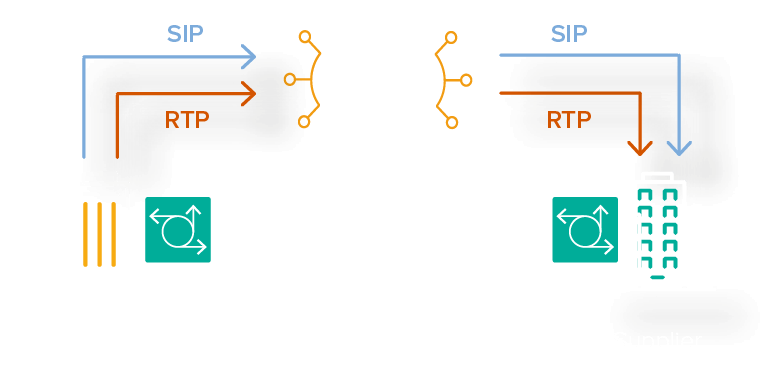
But is that rigidity of approach—such an automatic assumption that hiding your connections is the only path—potentially costing you, business and revenue?
Let’s take a look at what greater transparency might look like in telecoms, the opportunities that it affords, and what type of system you need to take advantage of that.
“Transparency” in this context means a concept known as Open RTP. Here, while the technical part of the telephone call still passes through your switch, the voice path is connected directly between the customer to the supplier, so customer and supplier know exactly who each other are. This new, direct flow can be seen in Figure 2.
Figure 2: Open RTP call flow

An analogy about the significance of this might be useful: imagine going to a restaurant, and being seated so that you can see the cook at work in kitchen, but also out of the back door to a supermarket on the other side of the street.
You give your order to the front-of-house staff, and watch as they walk straight out through the kitchen into the supermarket and come back with your steak and frites. At this point, you might be thinking “What a rip-off: I could have gone to the supermarket myself and bought exactly the same items for half the cost!”
Most of the time you would be absolutely right. But there’s a reason why most of us don’t go to restaurants daily: it’s an expensive way to eat. But we do go now and again--maybe because the restaurant is offering something we can’t get at home, more interesting dishes than you can knock up at home, cuisine you don’t know how to cook—sometimes, simply because we can’t be bothered to prepare dinner that night.
In other words, you go out to dine at a third-party place because in some way it adds value to the experience. It’s pretty similar with Open RTP.
In telecommunications, the added value lies in exclusivity and increased simplicity
Exclusivity relates to the fact that it is not possible for every business to form a link with every other provider out there. There are a few reasons for this, but a lot comes down to a limited licensing agreement: the majority of countries have some degree of restrictions on who can connect into the local PTT network, which tend to be signed with a few limited providers who have to meet certain obligations to route traffic into the country.
As with any market, this exclusivity creates a certain rarity that in turn leads to a premium on the price. This means that organisations that have signed such agreements with the incumbent provider, or even organisations a step further up the line who are connected to the transit organisation, have something of value in the marketplace. For instance, they can offer access to these exclusive routes – which, in turn, means you can charge more and hold your margins for this guaranteed outcome, but only if your customer can be sure of the outcome and its purported value.
This where the ability to safely offer and prove transparent routing will come into play. In the restaurant scenario, if you pay a premium for an expensive bottle of wine, you want to see that bottle and not some nameless plonk delivered in a suspicious-looking carafe! Similarly, when you pay a premium for something, your customers will expect proof of what they are paying for.
Simplicity relates to the nature of this business and its ever-changing web of providers. Organisations, especially larger operators moving high volumes of domestic and international traffic, have enough on their plate managing their core business. Therefore, it doesn’t make good business sense for them to go down the path of trying to discover and connect with the very best and most exclusive connections into each and every country around the world, because with that comes high levels of volatility and cost.
Much like in the virtual mobile space, they instead would prefer to deal with aggregators--who will in turn be finding and managing these challenging routes in the most effective way possible. The focus in these agreements will be meeting specified Quality-of-Service targets--and by facilitating direct and transparent voice paths, unnecessary networking transit is avoided. Even better, once more the end destination is visible, providing reassurance and credibility with these larger operators.
These are just two of the reasons that working with transparent routing might be the key to unlocking another new stream of revenue for you and your business. If that is the case, what are the three key things your routing platform requires in order to deliver this?
Our experience suggests you need:
1) Technical Capability
Your platform must have the ability to easily configure transparent Open RTP routing—but not only that, you need the ability to determine exactly what traffic should be sent transparently. You also need to know what should be masked to ensure your solution includes the ability to control routing transparency by both destination, origination and in combination.
2) Internal Visibility
Your platform must have the ability to provide detailed reporting on both the technical aspects of the transparent routing in terms of media addresses. It can then use this technical information to provide commercial insight into the performance of this routing and revenue it is providing.
3) External Visibility
Probably even more importantly, is the ability to communicate the internal visibility of transparent routes transparently and reliably to your customers. It must be possible to provide up-to-date real-time data from the platform, directly accessible by the customers who are paying for the transparent service (so they always see the label on the bottle). To be able to take advantage of this premium service, you need to be able to prove to these premium customers that you are meeting your end of the bargain.
The Right Platform in the Right Place
Digitalk Carrier Cloud provides all these key requirements - and more.
Our market-leading Business Intelligence solution leverages the power of the cloud to provide full reporting on your Open RTP routes. Combined with our innovative Origination Reporting, these tools can provide the rich data your internal teams need, as well as clarity and reassurance for external partners.
Your partners can access their own data through the Digitalk Partner Portal, when they want – giving them the visibility they need, while the native ‘real’ real-time monitoring dynamically manages your quality of service to ensure your agreements are met. The portal is illustrated in Figure 3, below.
Figure 3: Carrier Cloud portal

“Open RTP allows us to provide transparency for our voice transit services for our key strategic partners”, comments Birendra Singh, Head of Voice Operations & Collaboration services delivery of Sify Technologies Limited. “This not only gives reassures our customers that we are delivering on our promise of providing premium routes, but it also delivers enhanced operational efficiency and termination quality.”
Isn’t it time you did the same thing?
Share this post


